






5 min
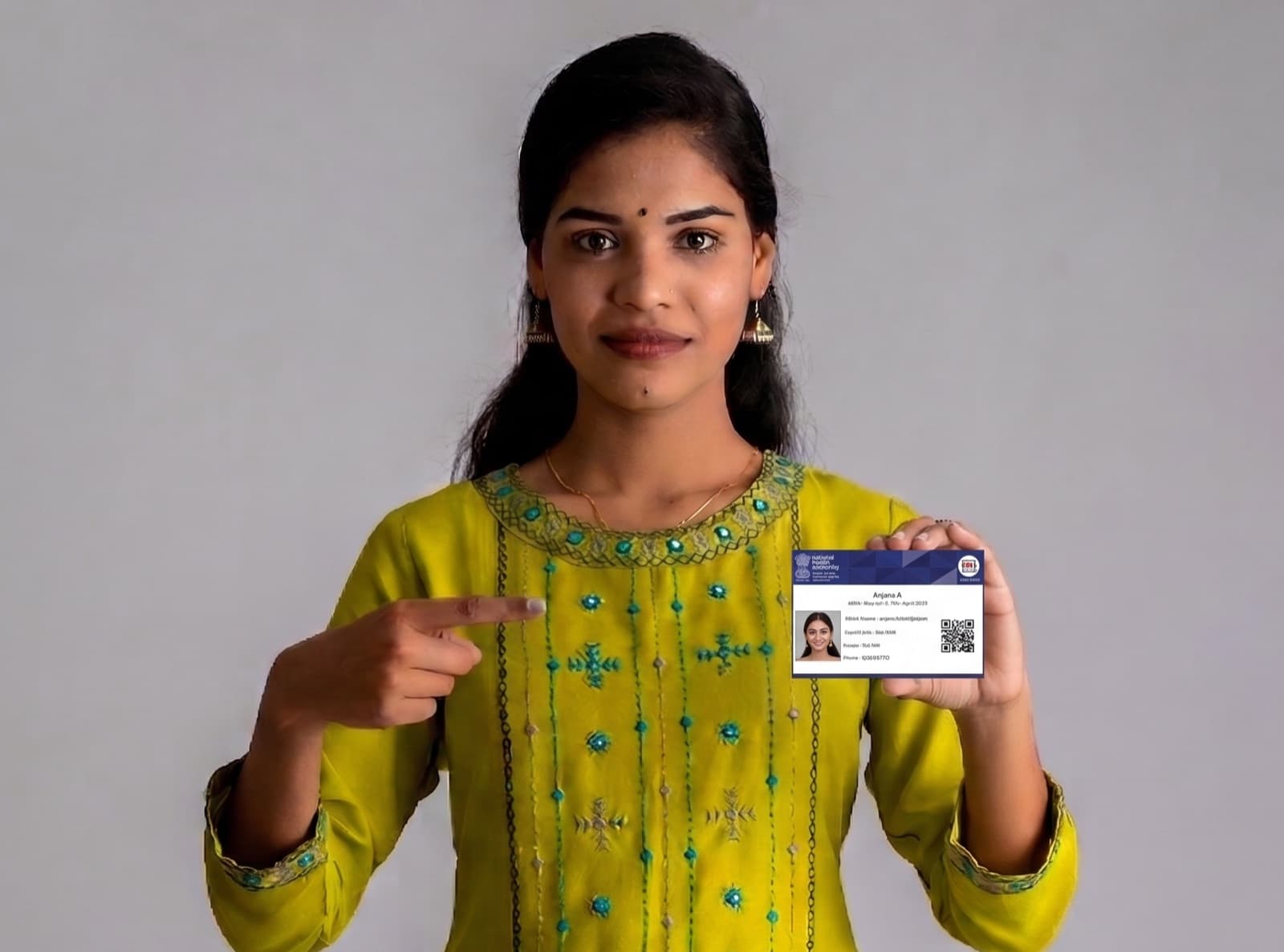
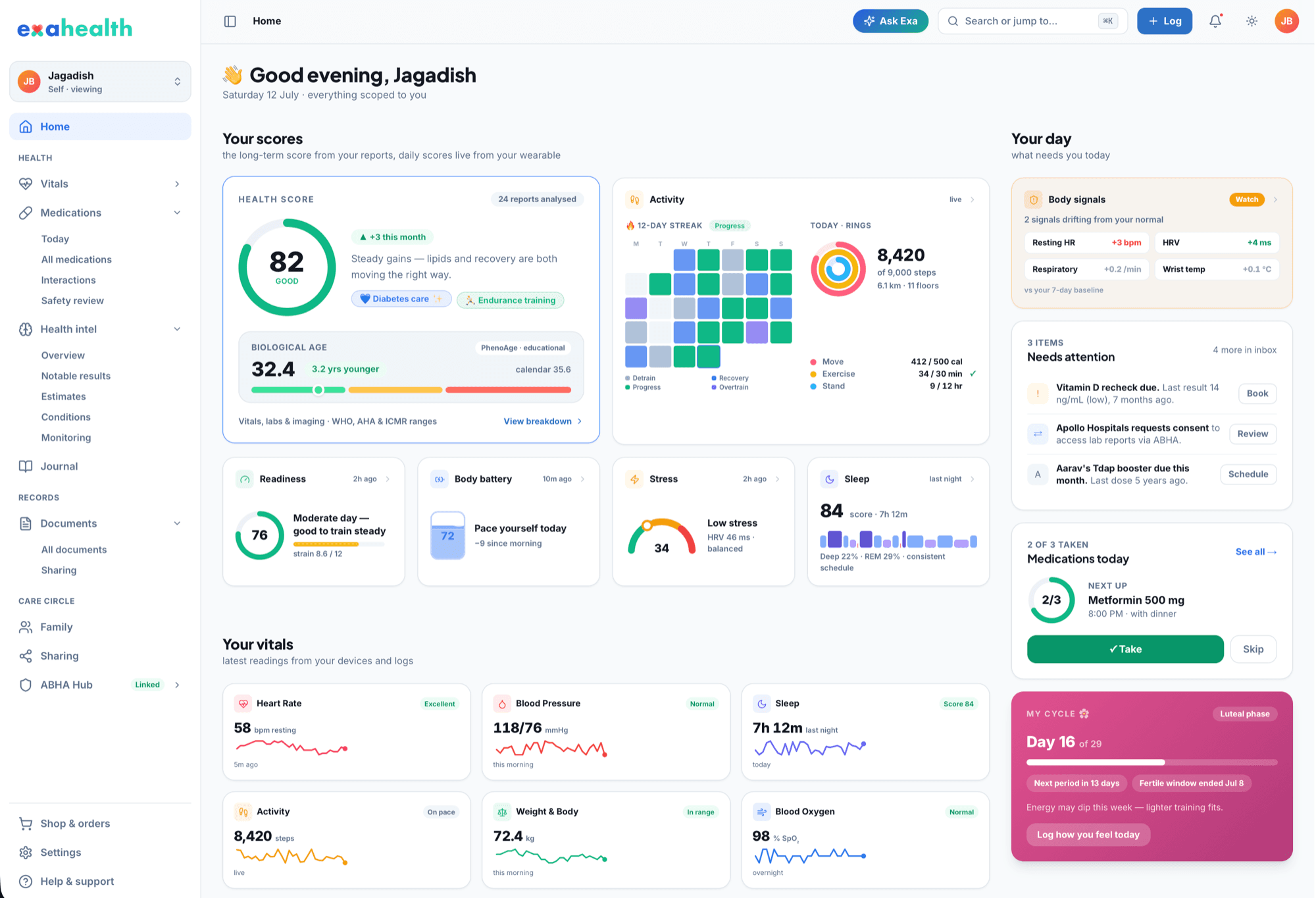
ABHA ID vs ABHA Number vs ABHA Address: What's the Difference?
ABHA ID, ABHA Number and ABHA Address sound similar but serve different purposes. Understand the difference with this simple guide.
Read more
Lab reports, vitals, medicines and scans — read, organized and explained for you and the people you look after. So you walk into every appointment prepared.
Need care now? Find doctors, blood or an ambulance →·Emergency 108




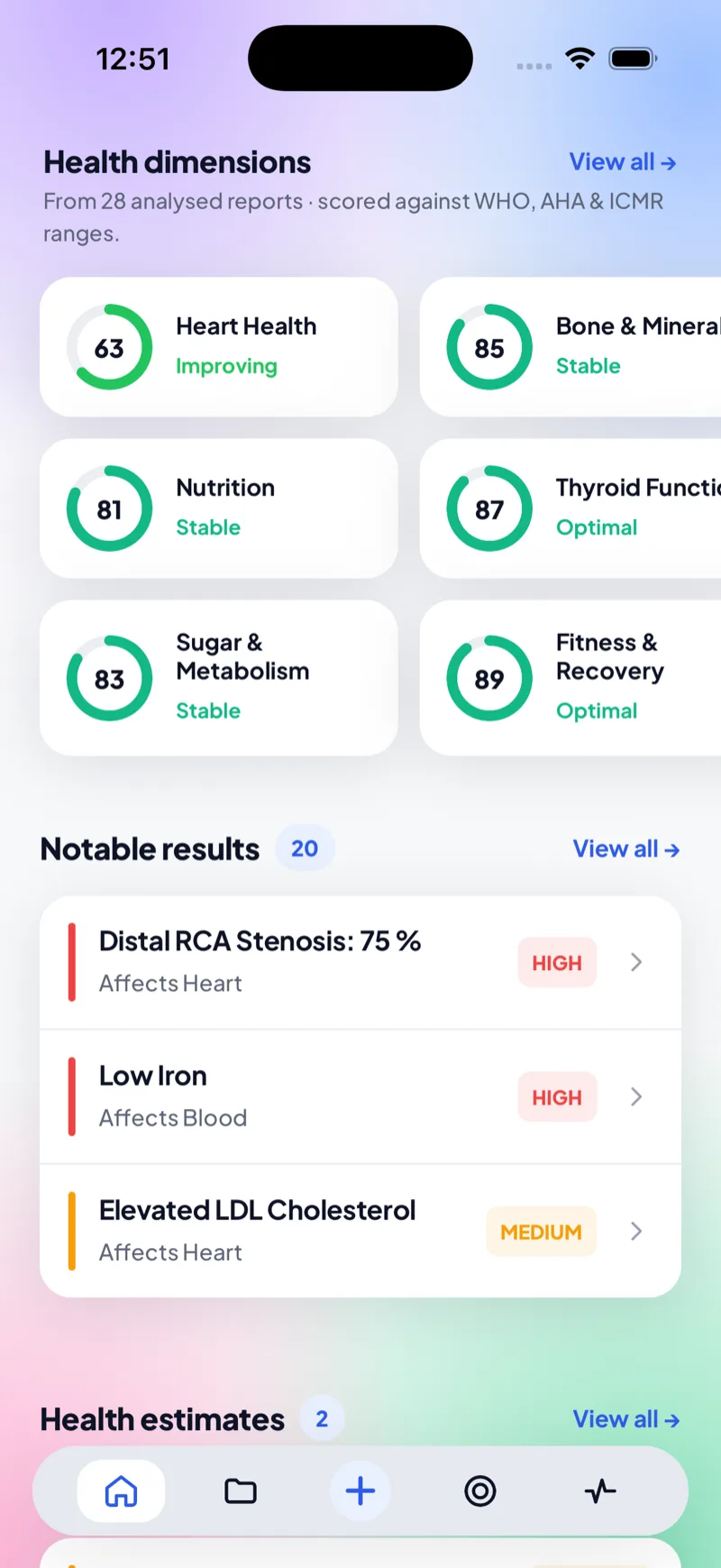
One account — the full picture in your browser, the daily companion in your pocket.
Care, on India’s health network
Doctors and clinics near you, live blood stock, private ambulances, generic medicines and government schemes — one search, and an honest way to reach every place.
One app, your reason
Your records are just the foundation. Each door opens what ExaHealth actually does for your life — daily scores, tracked conditions, medicine safety, family care. Everyone comes for their own reason, and discovers their whole health is connected.
The vault
Lab reports, prescriptions, scans, vaccinations, bills — filed to the right person, read into data you can search, with the original file always intact. This is where everything else begins.
Snap a photo
even a crumpled page
Forward on WhatsApp
it files itself
Drag whole folders
on the desktop web app
Pull via ABHA
from hospitals & labs
Connect a watch
vitals flow in daily
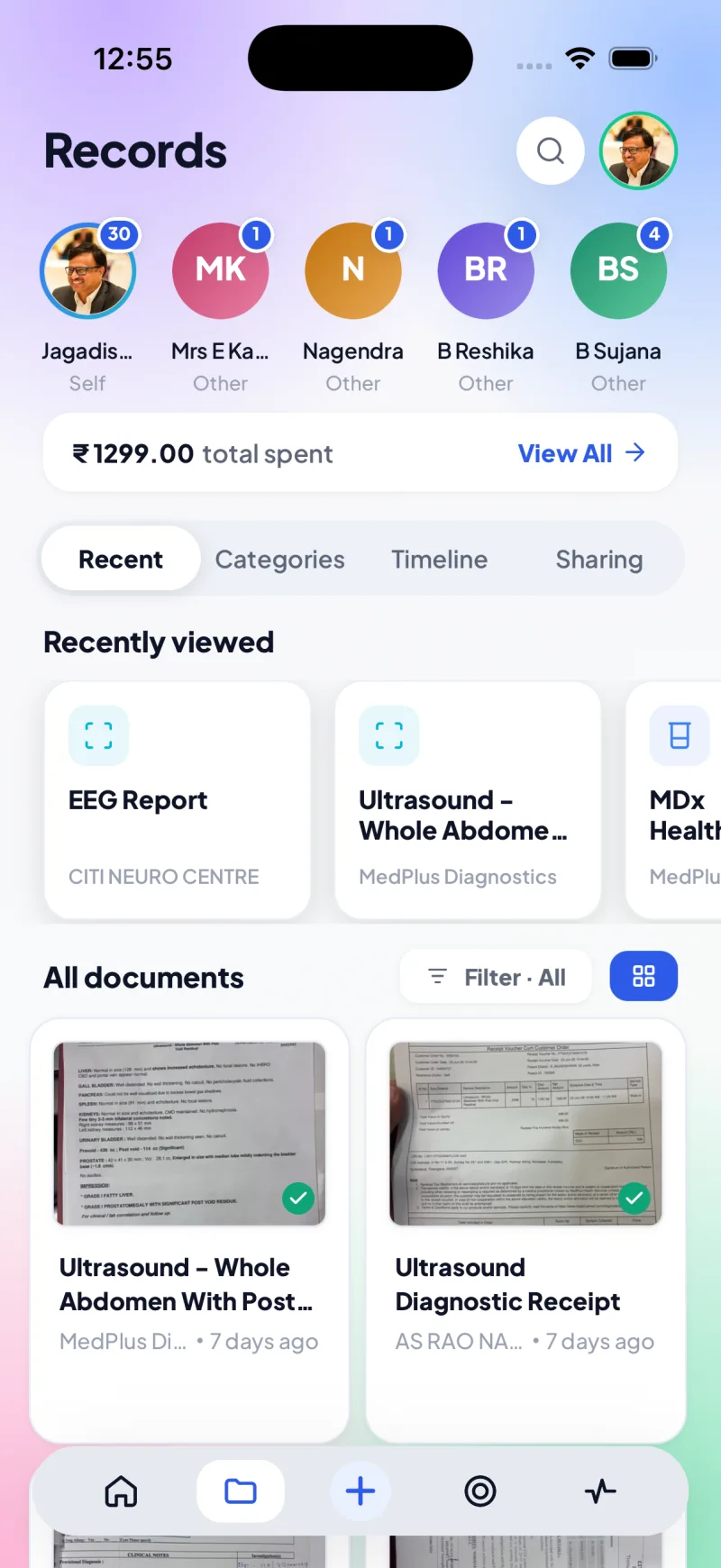
Documents
30 total · 4 family members✦ 30 AI insights readyUltrasound — Whole AbdomenAbnormal
25/6/2026 · Imaging report
CBC + Lipid panel — Apollo Diagnostics
2/5/2026 · Lab results
Prescription — Dr Meera Rao
2/5/2026 · Prescription · photo
Discharge summary — Yashoda Hospitals
18/4/2026 · Hospital record
Tdap vaccination — Aarav
3/3/2026 · Vaccination · his profile
Hospital bill — Apollo
18/4/2026 · Medical bill
— 24 more —
Ultrasound — Whole Abdomen
✓ Completeissuer, doctor and dates read from the file — nothing typed
Whole Abdomen (Bilateral)⚠ Abnormal
LIVER: normal in size (128 mm), increased echotexture, no focal lesions. GALLBLADDER: well distended, no calculi…
Filed to Jagadish · linked to the Fatty liver (grade I) condition · original file untouched, one tap away
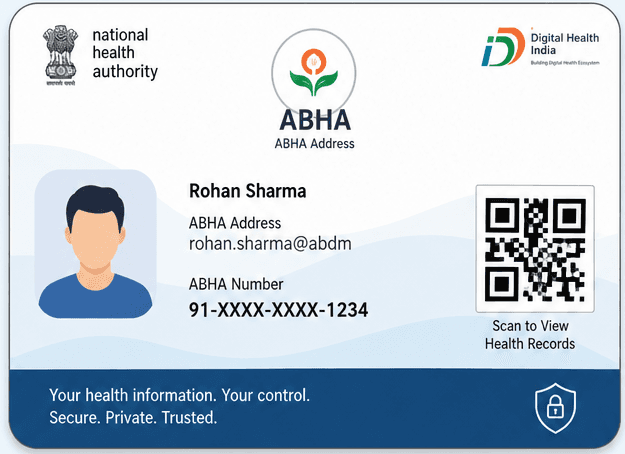
An ABDM health locker — not just a folder
Link your ABHA and records come to you — pulled from hospitals and labs across India into the same vault. Share onward only with consent you control, document by document, and revoke any time.
The depth, on one report
This is what happens in the minute after Papa’s lab report is uploaded — shown on a sample report, exactly as the app treats a real one.
Step 1 · Read
Upload a report — or forward it on WhatsApp — and it’s read, normalized and filed to the right family member. Nothing stranded in a chat thread.
MedPlus Diagnostics
Comprehensive Metabolic Panel · 12 Jul 2026
— 19 more rows —
Read in ~60 seconds
24 markers extracted — names, values, units and printed ranges
Units normalized — mg/dL vs mmol/L reconciled before anything is judged
Filed to the right person — this one carries Papa’s name — it goes to his profile
Kept as datapoints — every value joins his history, not a folder of PDFs
No typing. No data entry. Open any value to see the exact page it came from.
Step 2 · Judged fairly
Every marker is placed on curated WHO / AHA / ICMR / KDIGO ranges — and compared with his usual. And when a value can’t be classified safely, it says “no assessment” instead of guessing.
Severity · curated ranges, one source of truth
HbA1c
5.9 %
Prediabetic band per ICMR — worth a repeat in 3 months
LDL Cholesterol
138 mg/dL
Above target — and 22 points above his own usual
Vitamin D
14 ng/mL
Deficient range — commonly low, easily rechecked
Lipoprotein (a)
34 nmol/L
Unit under review — we say so instead of guessing
Two rulers, always: the published guideline range and his own baseline. When a value can’t be classified safely, it’s marked “no assessment” — never silently called normal.
Step 3 · Connected
Reports from different labs join into one trend, gaps in testing are flagged, and the direction — not a single scary number — is what you see.
LDL Cholesterol · 3 years
6 reports · 3 different labs
What the history adds
Same marker, three labs — different printed ranges reconciled into one line
Direction over drama — trending down since the statin started — visible in one glance
Gaps flagged — 14 months without a lipid panel is itself a finding
Step 4 · So what
A plain-language read of the whole report, plus a ready-to-share summary and the questions worth asking. Explanation is ours. Decisions are your doctor’s.
In plain words
Sugar control is borderline and cholesterol is above target, while kidney and thyroid values sit in range. Vitamin D is low. Nothing here is an emergency — and nothing here is a diagnosis. It’s a clear picture to take into the next appointment.
Educational insights — your doctor decides what they mean for treatment.
For the appointment
📄One-page summary of every graded result, ready to share
?“Should we repeat HbA1c in 3 months, or sooner?”
?“Is the LDL trend enough, or does the dose need review?”
?“Do we recheck Vitamin D after 8 weeks of supplements?”
Eight minutes with the doctor go a lot further when the questions are ready.
Educational insights — not a diagnosis. Always confirm with your doctor.
The intelligence layer
Keep scrolling — the window below walks through all four lenses the app keeps over the same records: conditions, estimates, the whole picture, and the schedule they add up to. Same Health intel that ships in the app, shown with sample data.
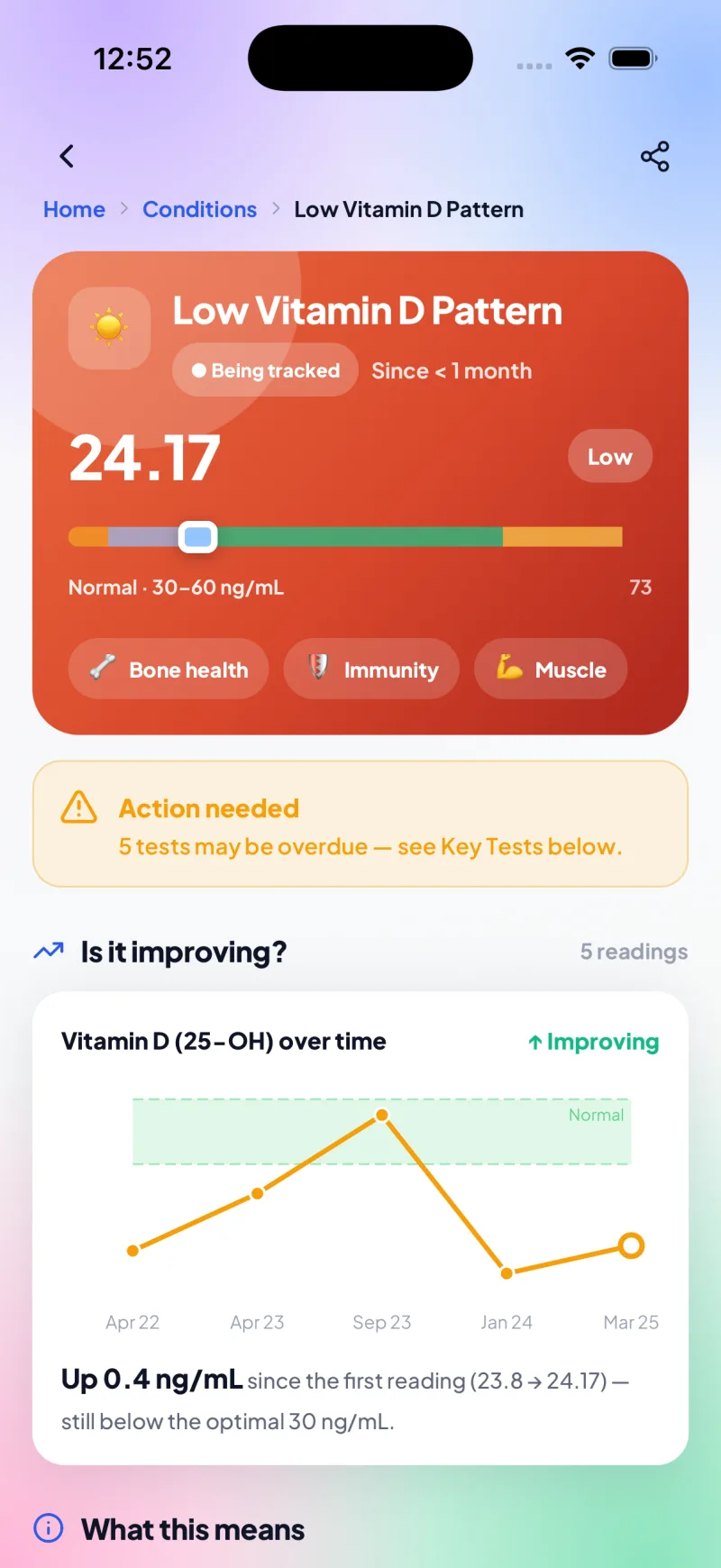
Lens 1 of 4 · Conditions, tracked
Patterns from labs, imaging & prescriptions — each with source, confidence and a plan
Being tracked
6 active conditions
Vitamin D deficiency and Dyslipidemia need attention; 3 are on a monitoring plan, and 1 is fully managed — treatment doing its job. 2 more resolved or dismissed, kept for history.
On medication
5 of 6
each named on its page
Checks planned
13
every one with its guideline
⚠ Overdue
1
urine albumin / creatinine
Needs attention · 2
Dyslipidemia (high cholesterol)
From your lab results · High · since Aug 2025 · 3 checks planned
158 mg/dL
LDL cholesterol · High
Monitoring · 3
Blood sugar in the prediabetic range
From your lab results · High · since Aug 2025 · 2 checks planned
6.1%
HbA1c · Borderline
Fatty liver (grade I)
From an imaging report · Medium · since Apr 2026 · 3 checks planned
46 U/L
ALT (SGPT) · Borderline
Early kidney strain (albuminuria)⚠ 1 overdue check
From your lab results · Medium · since May 2026 · 1 check planned
34 mg/g
Urine albumin / creatinine · Borderline
Managed & improving · 1
Hypothyroidism
From your prescription · High · since Sep 2025 · 1 check planned
2.4 mIU/L
TSH · In range
Identified from labs, prescriptions, scans and doctor’s notes — not diagnoses. Each names its source and confidence so you can judge it. Resolved conditions are kept for history, not deleted.
Lens 2 of 4 · Clinical models, run on you
PhenoAge, ASCVD, QDiabetes, KFRE — with confidence, gaps and drivers named
Biologically
41.2
vs
On the calendar
44
His blood chemistry resembles a typical 41-year-old’s. The lipids are pulling the wrong way; almost everything else is pulling for him.
PhenoAge (Levine et al., 2018) · computed from 9 of his own markers — each one inspectable
10-year cardiovascular risk
ASCVD
Next 10 years
6.2%
10-year diabetes risk
QDiabetes
Next 10 years
11.4%
5-year kidney failure risk
KFRE
Next 5 years
0.4%
Liver fibrosis score
FIB-4
Current state
—
Inside the 6.2% — what’s driving it
Pushing it up
LDL cholesterol158 mg/dL
Lipoprotein(a)a risk enhancer the base equation does not even include92 nmol/L
Holding it down
Systolic blood pressurehome average — the clinic reading would add ~1.4%118 mmHg
HDL cholesterol54 mg/dL
Non-smokerNever
Every input opens to its own history — and “Suggestions to discuss” frames the levers as questions for your doctor, never as prescriptions.
Lens 3 of 4 · The whole picture
14 dimensions honestly scored, and results sorted by direction — what needs you first
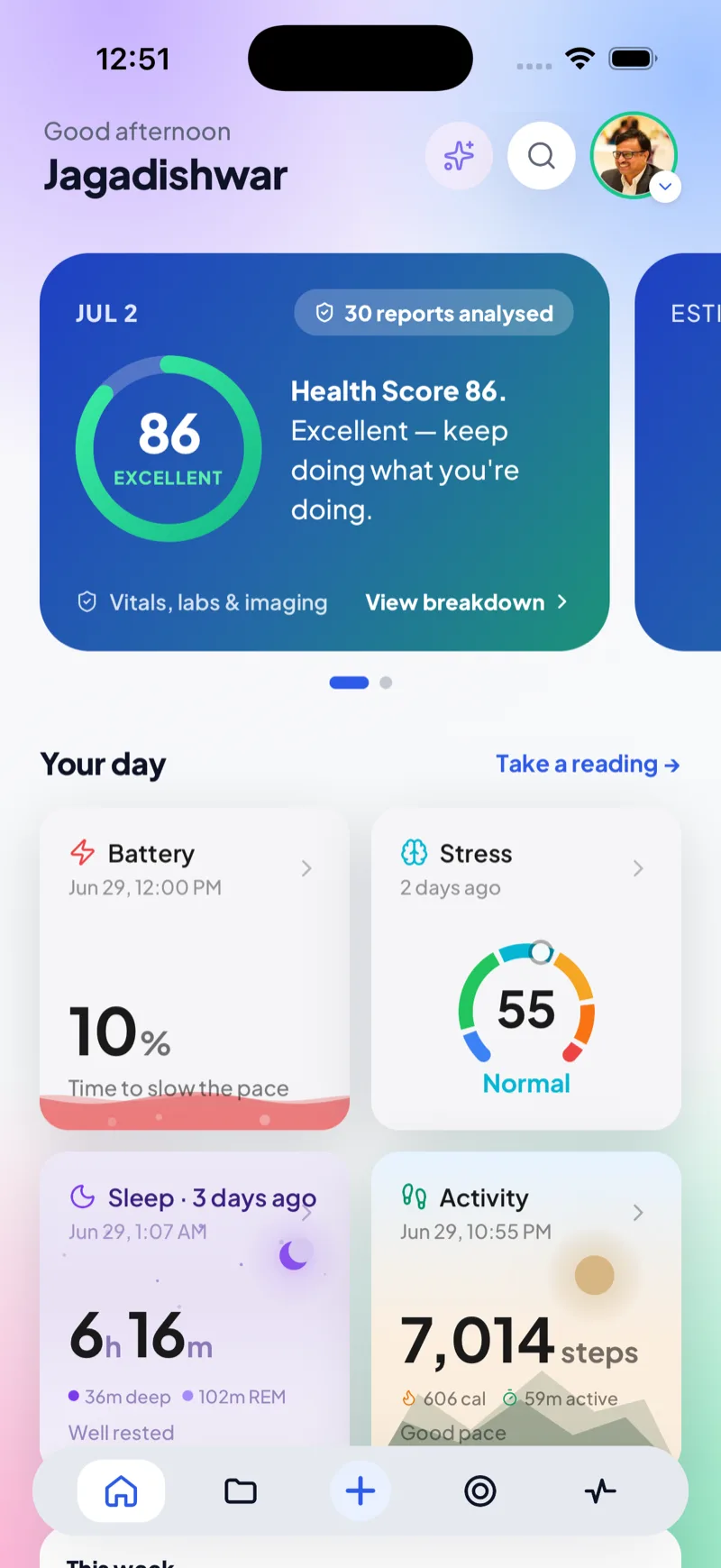
Health Score
78 Good
Strongest is Thyroid at 94; weakest is Nutrition at 58. The average covers only what could actually be scored — 4 dimensions have no data behind them and are left out rather than counted as zero.
13 results worth a look
3 improving, 4 getting worse — the direction matters more than the count. A raised marker that is falling and one that is climbing need completely different responses.
Vitamin D is well below range at 18 ng/mL
Apollo Diagnostics · Nutritional · Bone & Joint · improving on treatment
LDL, ApoB and non-HDL are all above range
Apollo Diagnostics · Cardiovascular · three raised together — a real pattern
Clinic blood pressure was 20 points higher than your own
Dr Meera Rao · Cardiovascular · 118/76 — average of 24 home readings
✓ Back in range — what you fixed
Triglycerides 168 → 128 mg/dL · Inflammation (hs-CRP) 4.2 → 1.2 mg/L — wins stay visible, not just worries.
Lens 4 of 4 · One schedule
Every check your conditions ask for — deduplicated, guideline-cited, blood-draws batched
Your schedule
15 checks, one schedule
Covering 6 tracked conditions plus general screening. Where two conditions watch the same marker, it appears once — this list is deduplicated, not padded.
⚠ Overdue
1
Urine albumin / creatinine
Next up
Aug 2026
Vitamin D
One blood draw
7 checks
share a single needle
Save a trip to the lab. 7 of the recurring checks ride on a single blood draw — Vitamin D · Calcium · Lipid panel · ALT · HbA1c · eGFR + creatinine · TSH. One visit covers 6 conditions.
Urine albumin / creatinine
Early kidney strain
34 mg/gBorderline
Repeat within 6 weeks of a raised resultKDIGO 2024
OVERDUE
Fasting insulin
Blood sugar in the prediabetic range
no result yet
Once, to stage it
NEVER DONE
DEXA bone density scan
Bone health · years of low vitamin D
no result yet
Once, as a baselineNot guideline-mandated at 44 — it says so
NEVER DONE
Assembled from your tracked conditions and published screening guidelines — the guideline behind every interval is named on its row, and a check no guideline demands says so. A planning aid, not an order form: confirm timing with your doctor.
Source + confidence named on every condition
A guideline cited on every interval
“Cannot compute yet” beats a made-up number
Direction over drama — improving vs worsening
Patterns and estimates are educational, computed from your own records — not diagnoses. Every one is a conversation to have with your doctor.
Vitals, in depth
Blood pressure, heart rate, blood sugar, weight — each tracked against your own baseline, explained in plain words, and watched overnight. Four of the twelve, up close — real screens, sample data.
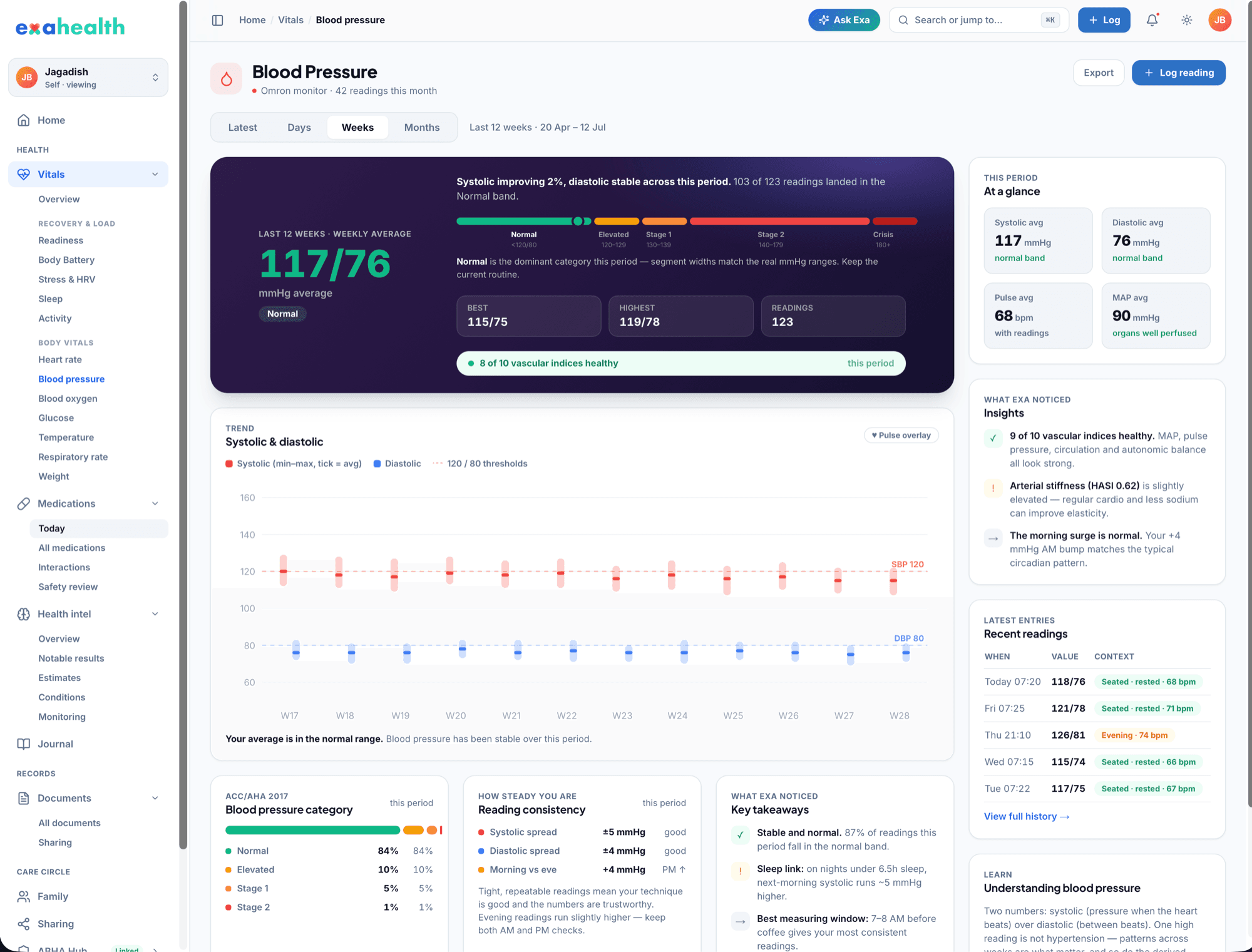
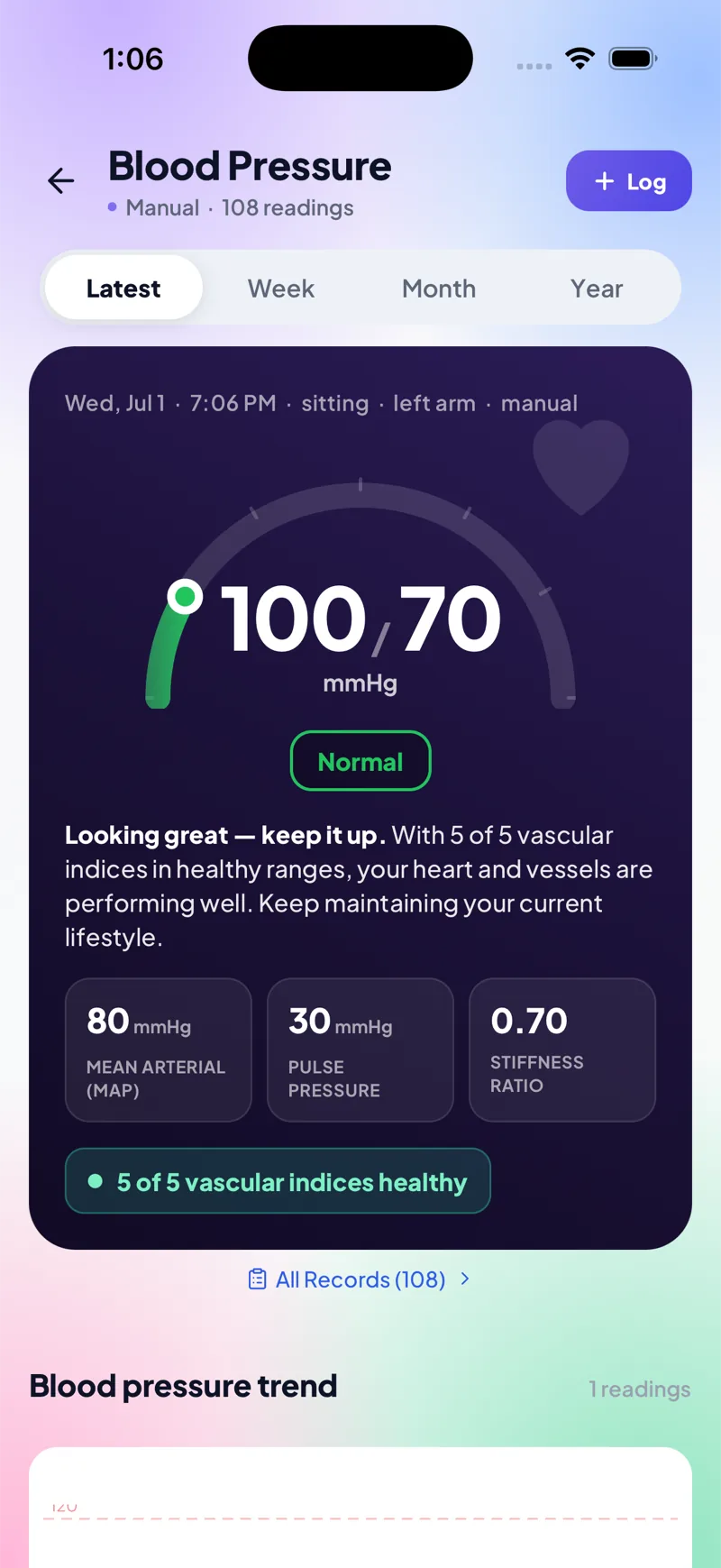
Blood pressure
A reading isn’t just filed. It lands in its ACC/AHA category, your technique is scored (±5 mmHg spread — trustworthy numbers), and your best measuring window is learned from your own mornings.
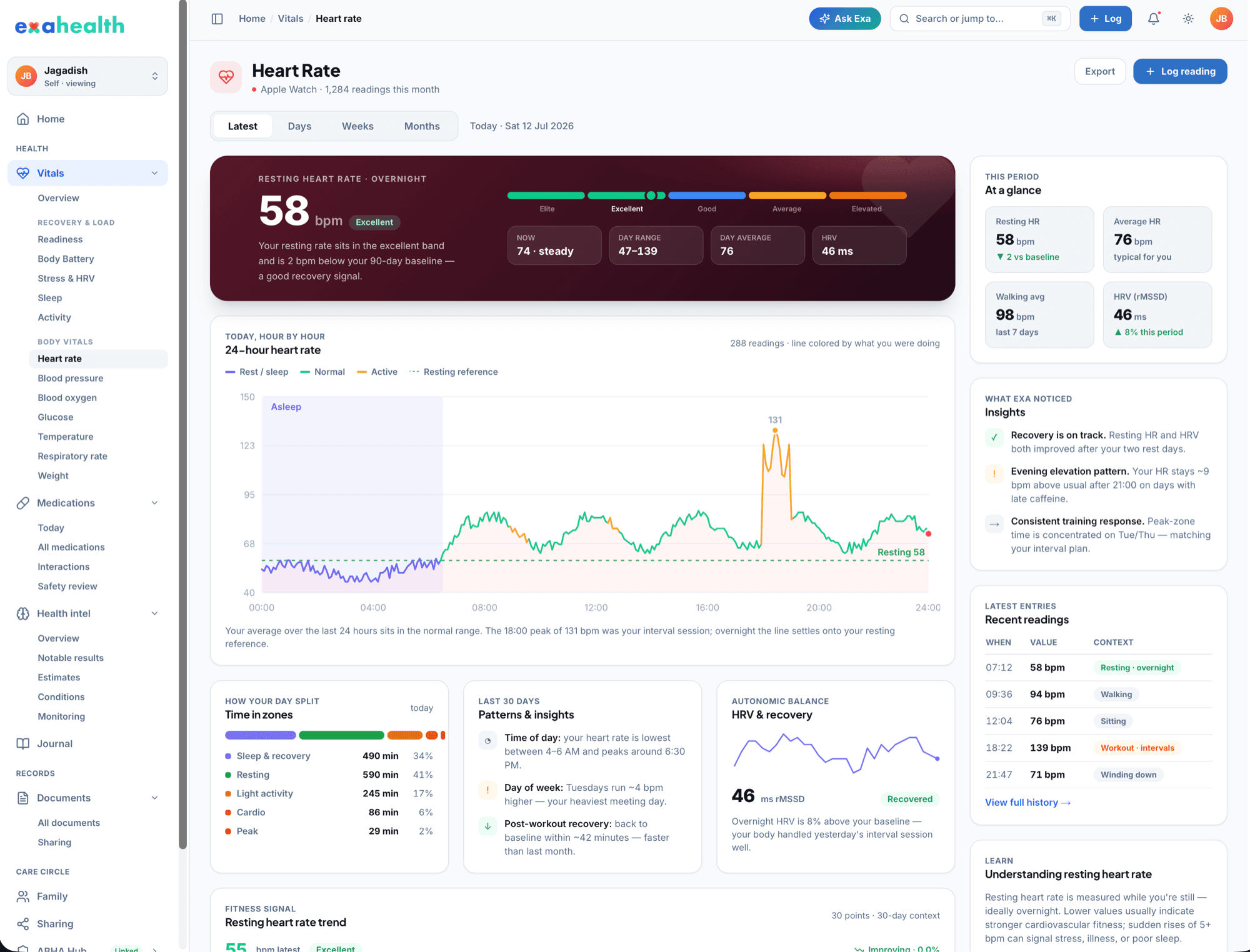
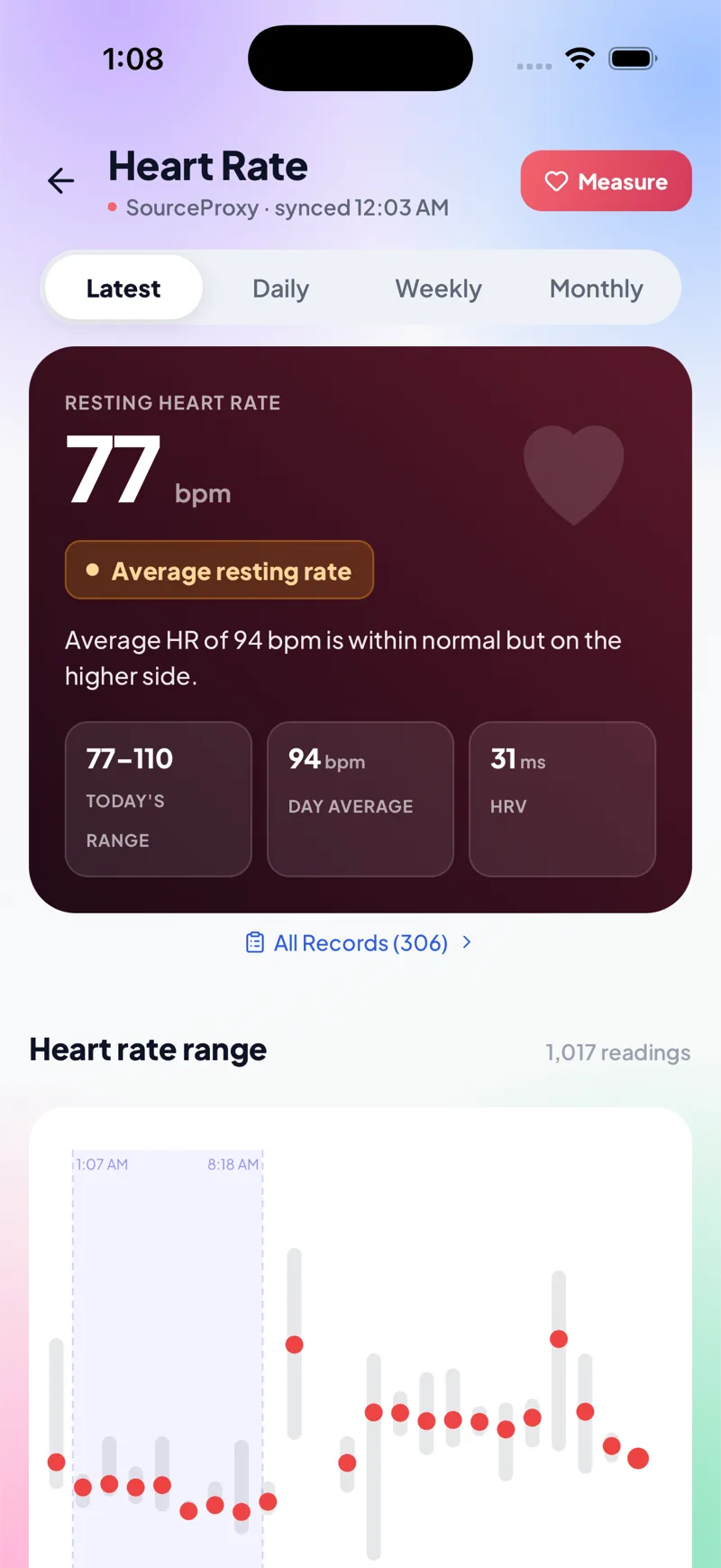
Heart rate
The 24-hour line is colored by what you were doing — so the 131 bpm spike reads as your interval session, not a scare, and the overnight settle onto your resting reference is the signal that matters.
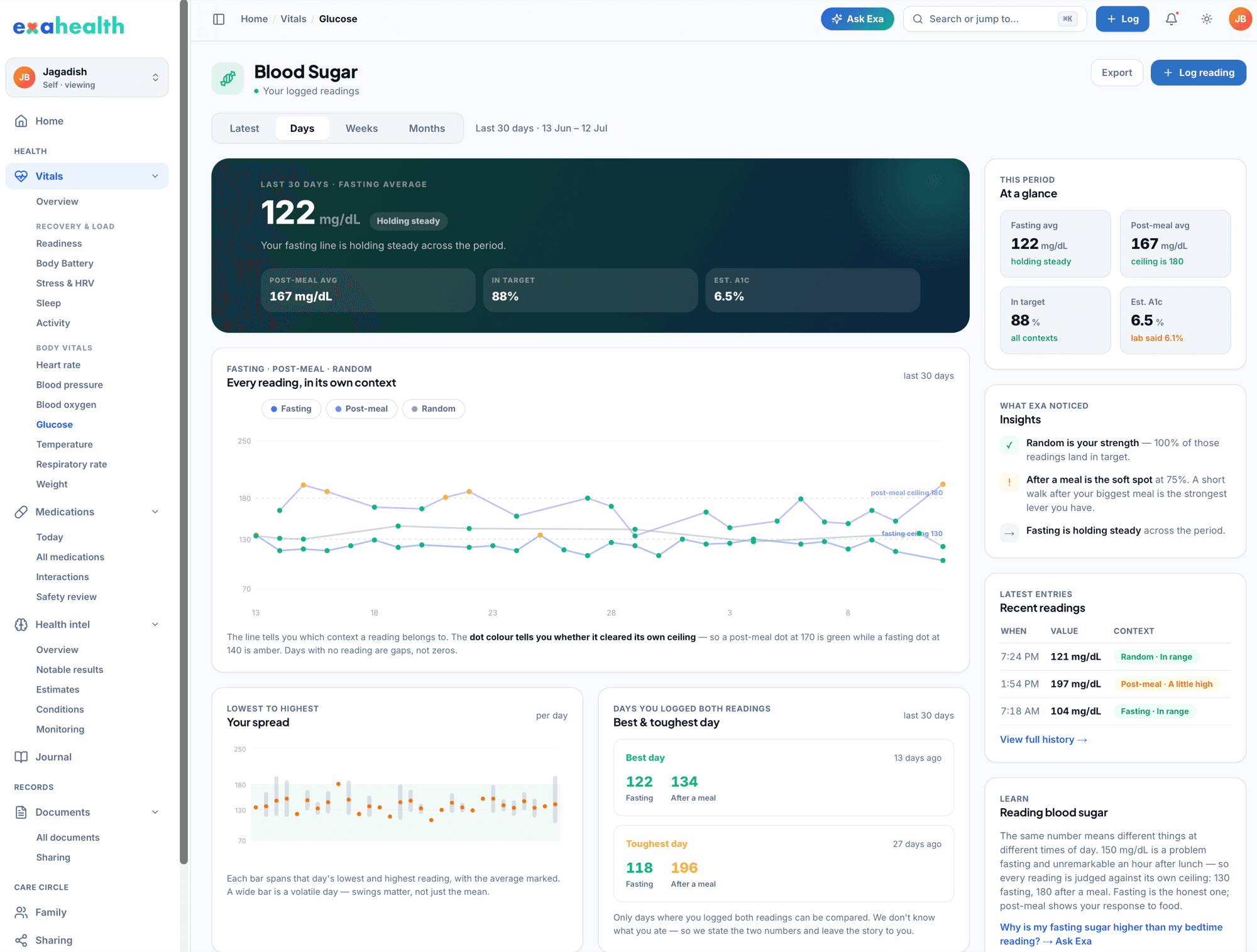
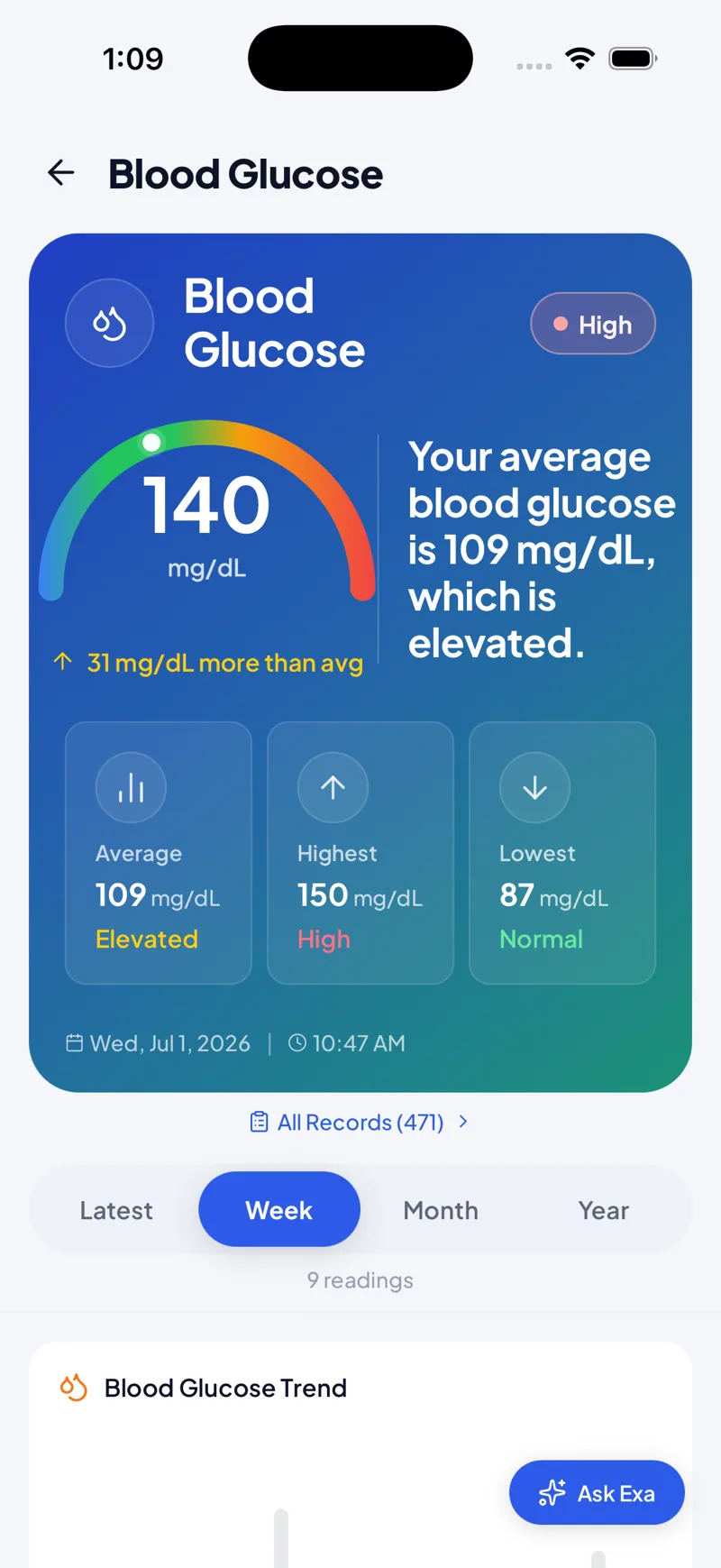
Blood sugar
A 140 after lunch is not a 140 fasting. Every reading is judged against the ceiling for its moment — and between lab visits, your meter readings roll up into an estimated A1c you can hold against the real one.
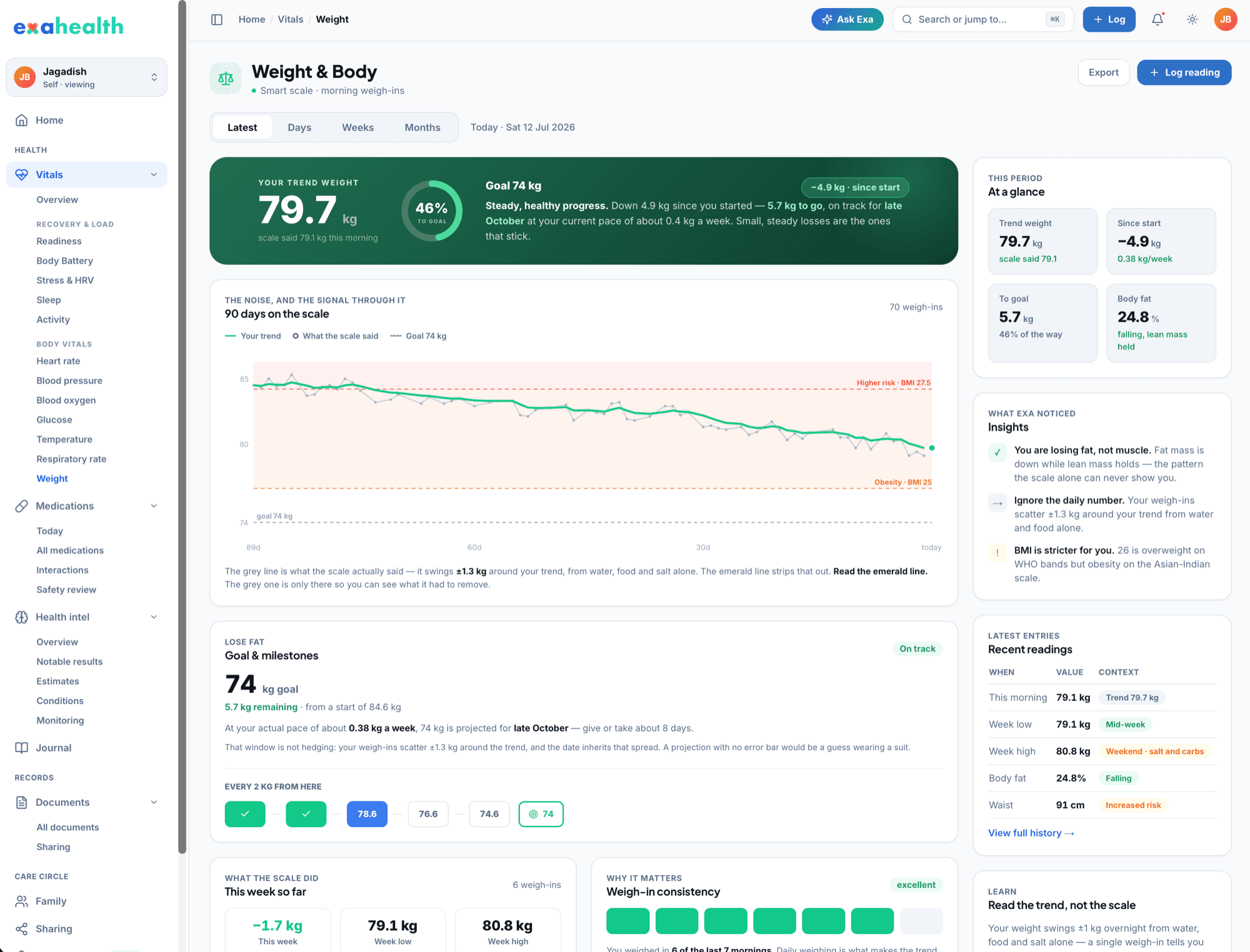
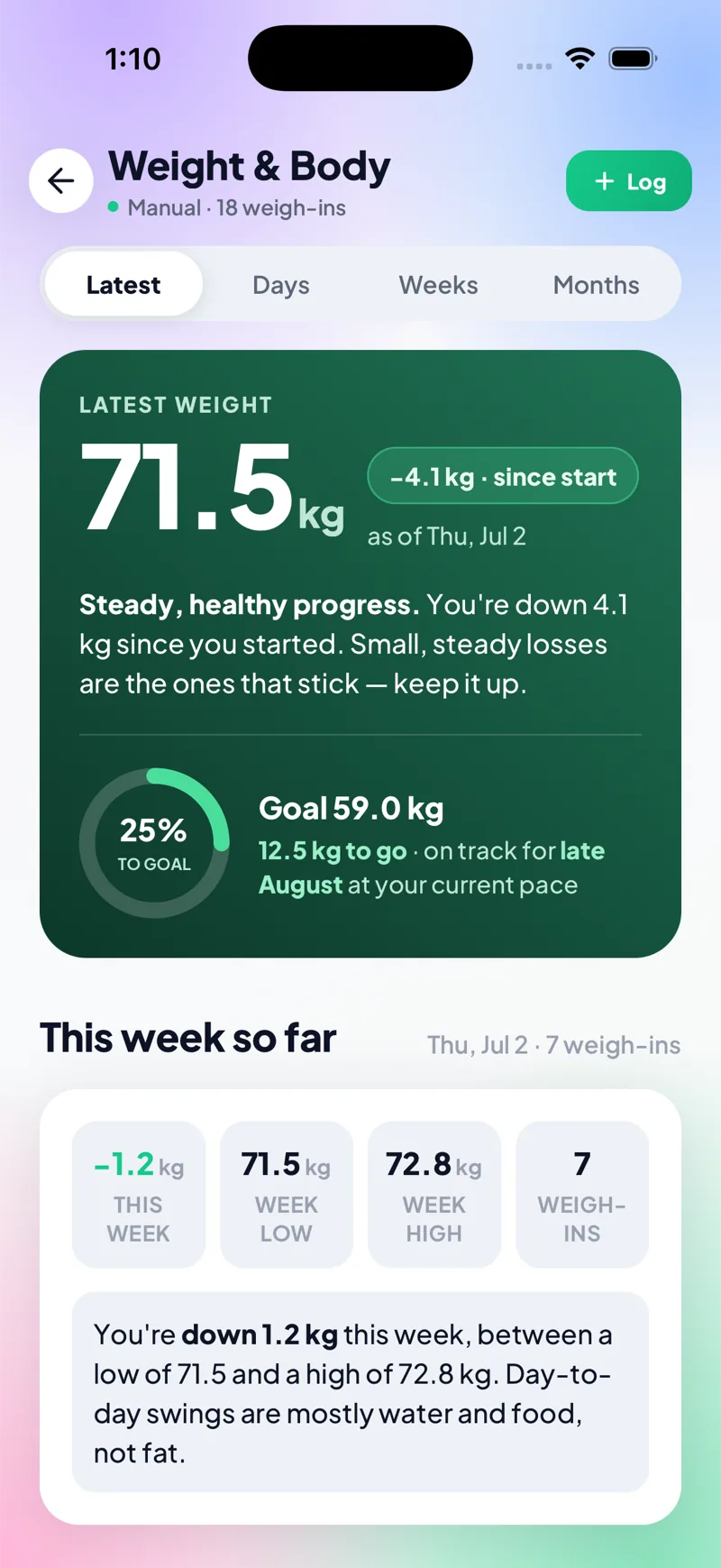
Weight & body
Day-to-day swings are mostly water and food, not fat — so it’s the trend that gets judged, never this morning’s scale. Your goal pace is computed from your own rate: 12.5 kg to go, on track for late August.
And while you sleep
Drift is caught early, signals explain each other, and home readings give the clinic number its context. No wearable? The phone camera can take a reading.
Overnight signal check
A resting rate 6 bpm high with HRV 5 ms low, together — most often a body under load, and one night of real sleep usually resets it. If it holds for days, that’s worth mentioning to your doctor.
Resting HR
64 bpm +6 bpm
HRV
46 ms −5 ms
Respiratory rate
14.3 brpm +0.5
Skin temperature
36.6 °C +0.1 °C
Blood oxygen
97% at baseline
the shaded band is your own usual range — not a population average
Signals that explain each other
Sleep × Readiness
Causer = 0.68 · 60 days of your own data
The 29 minutes you lost last night are the likeliest reason readiness is 9 points down — sleep doesn’t just correlate with your mornings, it feeds them.
66 signal pairs examined across your data. The ones that show nothing say so — a clean result is a finding, not a gap.
Home vs clinic
Your home average
118/76
24 readings
At the clinic
138/88
Dr Rao · 2 May
The white-coat gap is well documented — which is why home readings exist. Worth showing your doctor both numbers: it’s their call what to do with them.
…and every one of the twelve gets this treatment:
Blood oxygen
overnight dips flagged — the pattern clinicians screen for
Temperature
drift vs your baseline — the +0.5 °C line that often precedes illness
Sleep
stages, debt, and tonight’s plan
Stress & HRV
read from your heart rate — not your calendar
Respiratory rate
watched overnight, every night
Readiness
a daily verdict from your own signals
Body battery
what charged you, what drained you
Activity
rings, streaks and strain targets
Baselines are your own, insights are educational, and anything that holds for days is framed the same way everywhere: worth a conversation with your doctor.
Women's health
Most apps stop at a period tracker. This is one continuous record that follows her through every stage — first period, cycling, trying to conceive, pregnancy, postpartum, perimenopause and beyond. Switching stage changes what the hub emphasises; nothing resets, nothing is deleted.
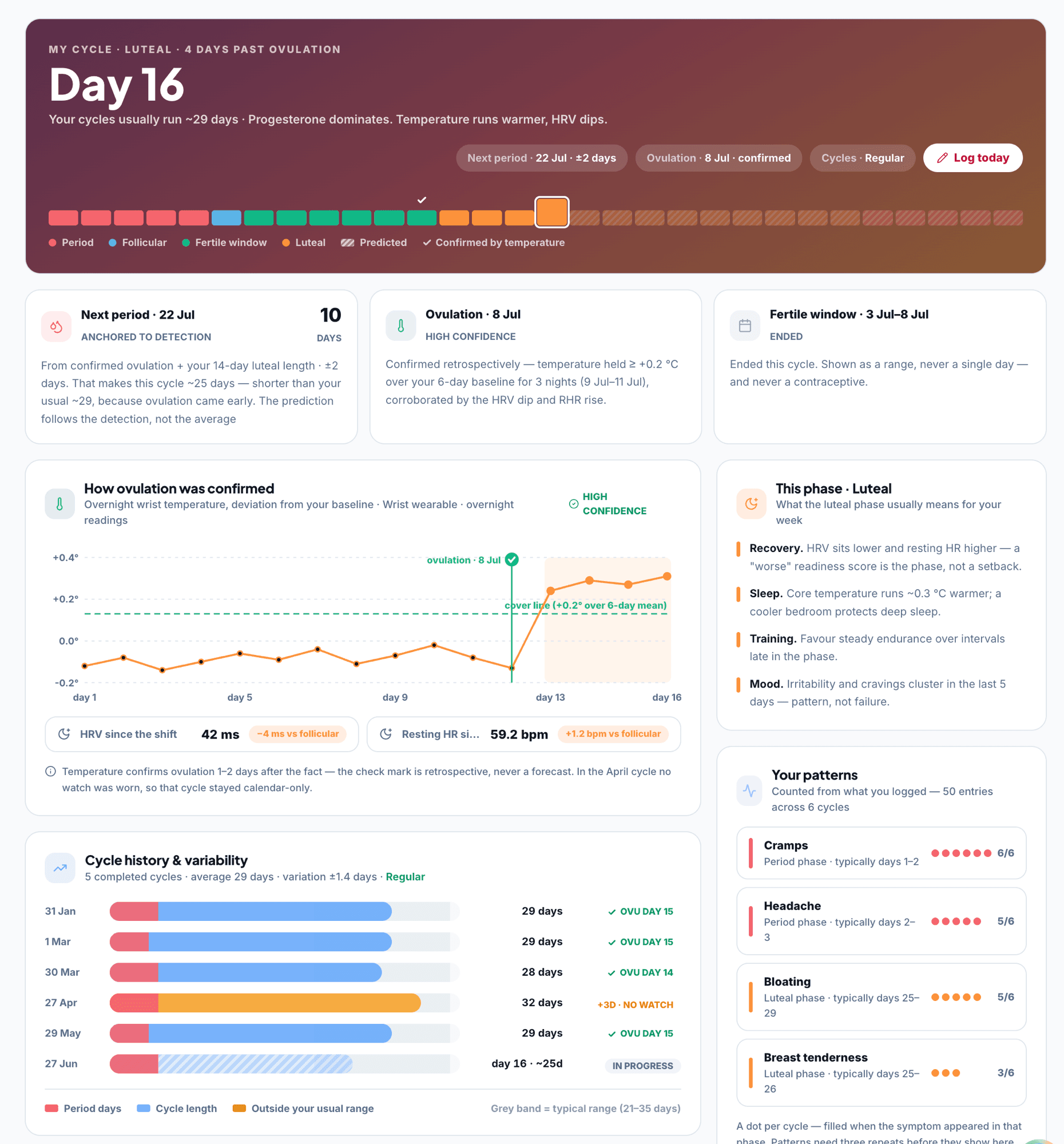
The cycle page
Overnight wrist temperature holds above your own baseline for three nights, corroborated by the HRV dip and resting-HR rise — so the checkmark lands 1–2 days after the fact. It is retrospective by design, never a forecast.
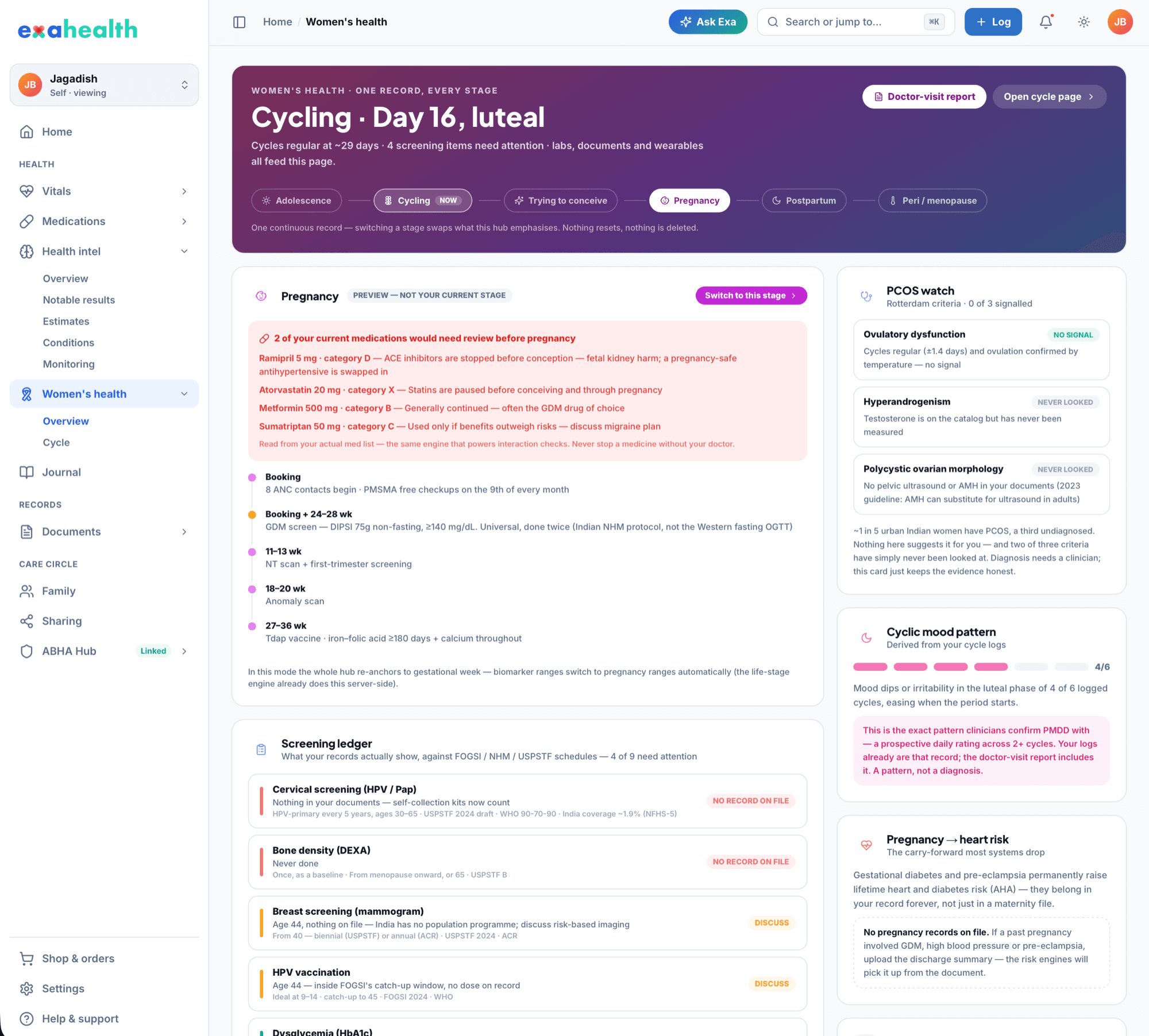
The life-stage hub
Cervical (HPV/Pap), DEXA, mammogram, HPV vaccination, thyroid, ferritin — each checked against FOGSI, NHM and USPSTF schedules for your age and stage, read from your own documents and labs. The same care-gap engine as Monitoring, seen through this life stage.
Private by architecture
Roughly 80% of period apps share this data with third parties. That is an industry we are not joining. Your cycle and women's-health records sit behind their own consent category — hidden from family sharing and caregiver access unless you grant it, per profile.
No third-party sharing, ever
Not sold, not brokered — the default, not a setting
Discreet mode
Lock-screen alerts never name the subject
Consent-gated
Its own category — off from family sharing unless you allow it
Coercion-aware
Surfaces Women Helpline 181 — it never acts on your behalf
Ovulation is confirmed after the fact, never forecast; the fertile window is a range, never a contraceptive; patterns are patterns, not diagnoses. Anything that needs a clinician is framed that way — worth a conversation with your doctor.
Medicines, watched
Interactions flagged before the first dose, each drug’s effect on your own numbers made visible, and the side-effects worth watching put on the schedule — with every decision left to your prescriber.
His current medicines
New prescription scanned — Clarithromycin 500 mg, 5 days (for a chest infection). Checked against the whole list before the first dose:
Known interaction · Clarithromycin × Atorvastatin
These two compete for the same clearance pathway — statin levels can climb and with them the risk of muscle damage. Doctors often pause the statin for the antibiotic course.
Flagged the moment the prescription was scanned — before the first dose. The decision is your prescriber’s: this note is written to be shown to them.
Clarithromycin × Ramipril✓ no known interaction
Clarithromycin × Metformin✓ no known interaction
Clarithromycin × Cholecalciferol✓ no known interaction
Every new medicine — typed, scanned or received via ABHA — is checked against the whole list, not just the newest pair. Confirm any change with your prescriber or pharmacist.
What each medicine does to his numbers
Atorvastatin → LDL176 → 149 mg/dL
The trend since it started, drawn from his own panels — so “is it working?” has an answer.
Ramipril → kidneysprotective
The drug that protects against exactly the albumin leak being watched — which is the reason not to stop it without asking.
Metformin → Vitamin B121433 → 547 → 368 ▼
Long-term metformin can lower B12 — his is falling across three tests, so a recheck sits on the schedule. A side-effect watched before it becomes a symptom.
Medicines × vitals × sleep
Missed evening doses × home BP: on the 14 days a dose was skipped, his home average ran +6 mmHg. Adherence, made visible in his own numbers.
Short sleep × next morning: nights under 6 hours are followed by HRV −4 ms and resting HR +3 bpm — the pattern behind the groggy days.
Observed patterns in his own data — shown to prompt the right conversation, never asserted as cause and effect.
For the appointment
One tap turns everything above into a one-page visit report — lifestyle, vitals, conditions, every abnormal value with its trend, and the questions worth asking.
Jagadishwar Balla
44 yrs · male
Cardiology visit
Dr Meera Rao · 1 Jun 2026
Lifestyle · 30-day avg
Sleep6h 42m/night
Steps6,120/day
Exercise18 min/day
ActivityLight
Vitals · home readings
BP average121/79 mmHg
Elevated3 of 24 readings
Resting HR64 bpm
SpO₂ · HRV97% · 46 ms
Active conditions
each with source & confidence inside the app
Abnormal results · direction across visits
| Test | Sep 25 | Jan 26 | Mar 26 | Ref |
|---|---|---|---|---|
| Cholesterol — LDL | 100 | 112 ▲ | 149 ▲ | under 100 |
| TSH | 4.75 | 0.89 ▼ | 7.73 ▲ | 0.4 – 4.0 |
| Vitamin D (25-OH) | 33.5 | 22.2 ▼ | 24.2 ▲ | 30 – 100 |
| Creatinine — serum | 0.67 | 1.19 ▲ | 1.06 ▼ | 0.66 – 1.09 |
a single value never stands alone — the doctor sees where it came from and where it is heading
Discuss with your doctor
Care schedule
Complete lipid panel85d OVERDUE
hs-CRP · ACC/AHADUE
Anxiety screening · USPSTF 2023DUE
ExaHealth · Generated from patient health data using AI. AI can make mistakes — verify all values with the original reports and consult your doctor.
Modeled on the actual report the app generates — sample data.
Built from everything above — labs, vitals, conditions, medicines — at the moment you need it. Never stale, never retyped.
Each number carries the lab and the visit it came from, with its direction across visits — so the doctor trusts it at a glance.
Written from his actual numbers — LDL 149, TSH 7.73 — so eight minutes with the doctor start at the point, not at the history.
PDF on WhatsApp before the visit, printed for the clinic folder, or opened from the QR code. Doctors keep it because it is short.
Meet Exa
Exa answers from your family’s own records — labs, vitals, medicines, history — in plain words. It explains and prepares. It never diagnoses, and it always points you back to your doctor for decisions.
Exa
knows Papa’s records · answers from his data
Papa’s creatinine is 1.4 — should we worry?
I can see why that line worries you. Here’s his context: creatinine has read 1.3 → 1.4 → 1.4 across the last three reports, and his eGFR has stayed around 58 — stable, in the mildly-reduced band his doctor already knows about.
Creatinine · 18 months
holding steady · his usual band shown
Stable isn’t the same as fine — that’s his doctor’s call, not mine. At the next visit, worth asking: “eGFR has been ~58 for a year — do we keep the 6-month check, or test sooner?” I’ve added it to his appointment notes.
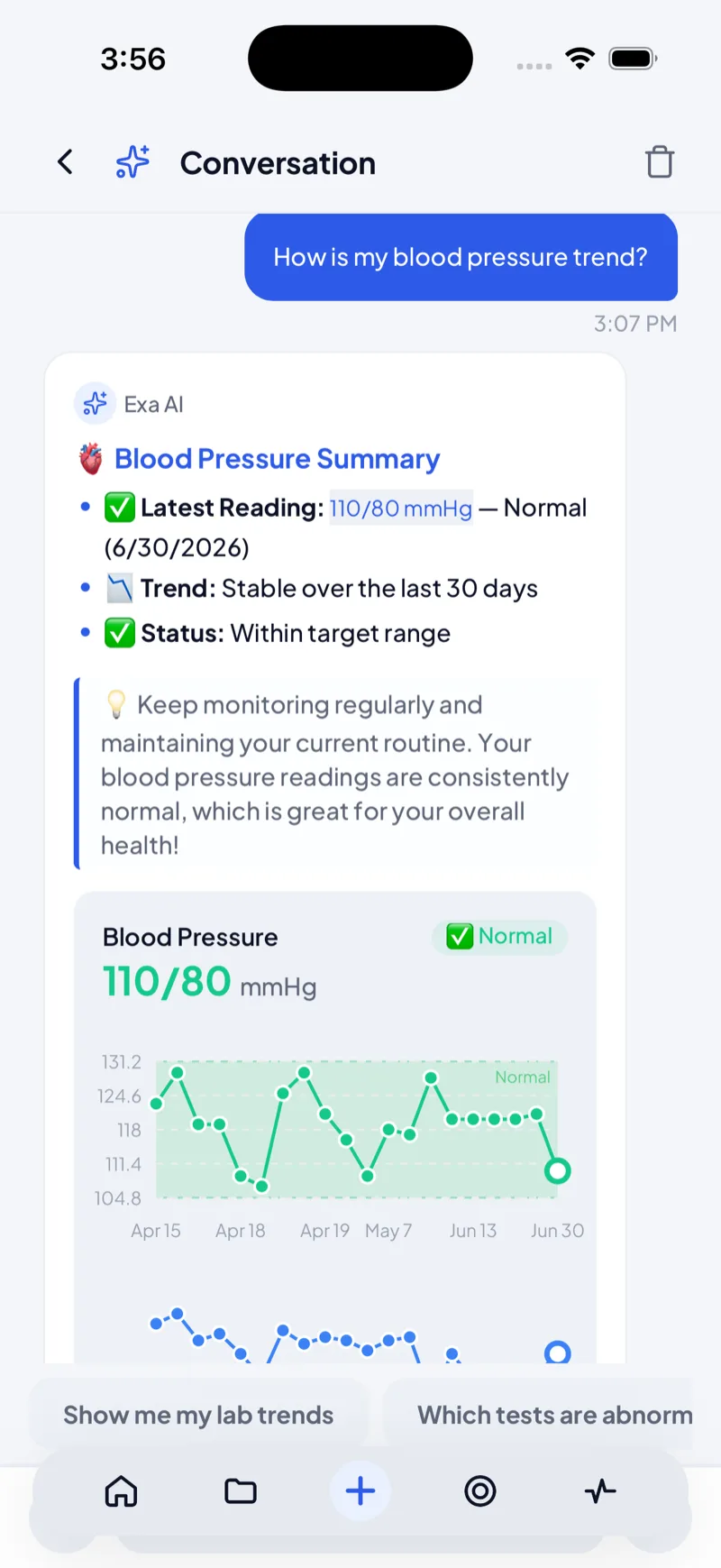
The same Exa on WhatsApp. Your parents don’t install anything — they forward a report, ask in their own words, and get their documents back on demand. Try it now →
Guardrails, not guesswork. Exa explains and prepares — it never diagnoses or prescribes. Every answer stays grounded in your data and points you to your doctor for decisions.
Real science, shown working
Every number in ExaHealth can be traced to a published model, a recognized guideline, or your own baseline — and the app shows you which.
RMSSD, SDNN, pNN50, frequency-domain power (VLF/LF/HF) and nervous-system balance — the same metrics used in autonomic research, not a made-up “wellness index”.
Our stress score is built on the Baevsky Stress Index, a validated measure of autonomic strain used in clinical and aerospace medicine for decades.
Your biological-age estimate uses the published PhenoAge model over your actual blood biomarkers — with every contributing marker shown.
Every severity call comes from curated reference ranges — stratified by sex and life stage. If we can’t classify a value safely, we say so instead of guessing.
Scored against global & Indian guidelines
 WHOWorld Health Organization
 AHAAmerican Heart Association
 ADAAmerican Diabetes Association
 ICMRIndian Council of Medical Research
 KDIGOKidney Disease: Improving Global Outcomes
 ATAAmerican Thyroid Association
Trust, in writing
Free storage forever — even if you never pay us a rupee. Export or delete everything, any time. Your data is never sold.
ExaHealth is an ABDM-integrated health locker. Link your ABHA on the web app to pull records from hospitals and labs across India — with consent you control, down to the document.
Your health data is stored on servers in India, encrypted at rest and in transit.
Share with a doctor or family member as view-only, see when it’s opened, and revoke access anytime.
An ABDM-certified PHR & Health Locker under India’s Ayushman Bharat Digital Mission — link your ABHA to pull and share records across hospitals and labs, with consent you control. And live on UHI, India’s Unified Health Interface — search blood stock, ambulances, doctors and government schemes across the national health network.
ABHA linking is available on the ExaHealth web app and in the iOS and Android apps. ExaHealth is educational — it never replaces your doctor.
Our web and mobile apps were launched by Shri G. Kishan Reddy, Hon’ble Union Minister for Coal and Mines, Government of India, on .
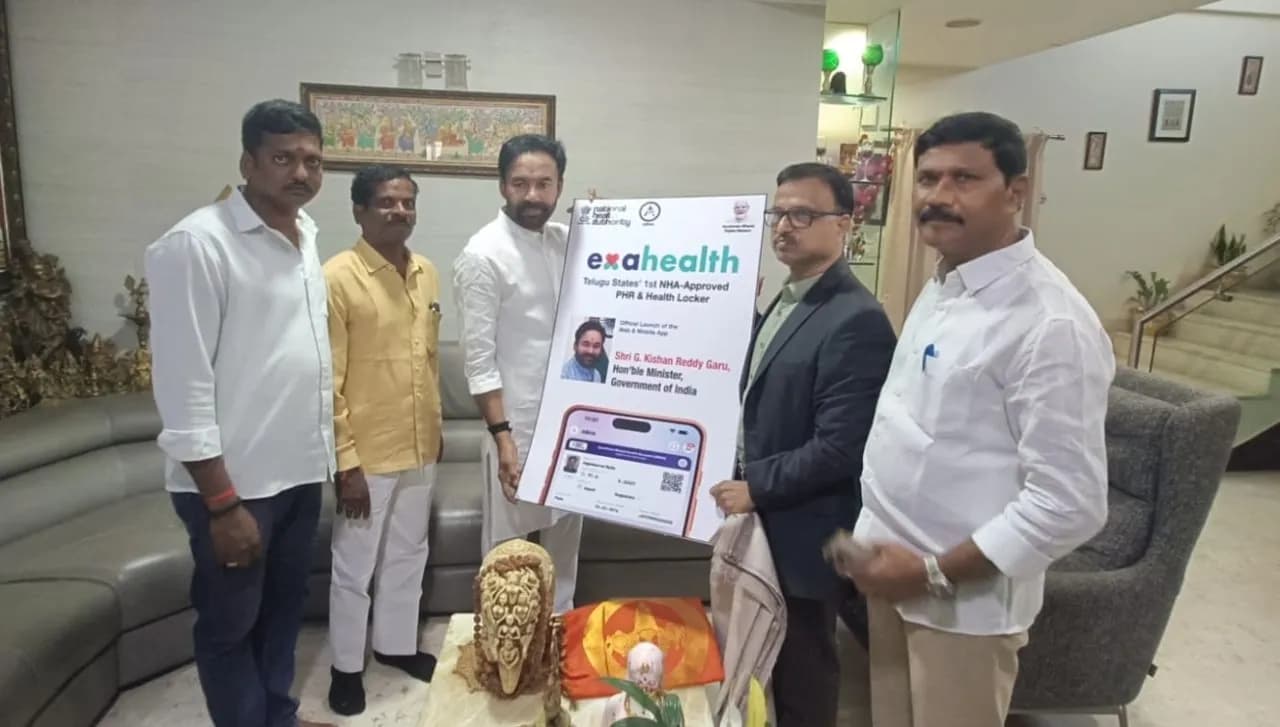
Shri G. Kishan Reddy and attendees at the ExaHealth launch event, Hyderabad, .
Getting started
Step 1
No credit card. Your vault — documents, family profiles, medications — is free forever.
Step 2
Pair your watch, connect Gmail, snap a prescription — or just forward a report on WhatsApp.
Step 3
Within minutes: your score across 14 dimensions, what’s driving it, and what to do next.
Pricing
Your vault is free forever. Upgrade when you want the full picture.
Your family's health vault
₹0forever
Full health intelligence
₹2,999/year
That's about ₹8 a day.
Cancel anytime. Your vault stays free.
All-in-one health plan
₹9,999/year
Billed annually. Works out to about ₹833/month.
Everything in Plus, plus:
Questions
Yes. Storing your family’s documents, medications and manual vitals is free forever — no credit card, no trial clock. You only pay if you want full AI intelligence (Plus).
Start in your browser or on your phone — upload one report or connect your watch, and see your family's picture come together in minutes. The vault is free forever.
For doctors & clinics
ExaHealth isn't just for patients — Solo doctors and clinics use it to run appointments, prescriptions, billing and ABDM compliance from one WhatsApp-native app.
Research-backed insights on health markers, wellness scores, and health optimization — tailored for Indian health patterns.
Latest news, product updates and articles — health, ABHA/ABDM, and everything else happening at ExaHealth.